For years, cosmetic treatments were predominantly marketed towards women, but attitudes towards male grooming, body confidence and aesthetic procedures have changed considerably. Today, men are increasingly exploring ways to improve their appearance, particularly when regular exercise and a healthy diet fail to address stubborn areas of body fat.
From reducing chest fat and tackling a double chin to improving the appearance of back fat and love handles, non-surgical body contouring offers a range of options for men who want to refine their physique without undergoing invasive surgery.
However, with so many treatments available, an important question remains: how effective are these procedures, and can they genuinely deliver noticeable results?
Understanding how different technologies work, what they can realistically achieve and which areas respond best can help men make informed decisions about body contouring.
Why men are considering non-surgical fat reduction
Even men who exercise regularly can struggle with unwanted fat deposits in specific areas of their bodies.
Genetics, age, hormones and lifestyle all influence where fat accumulates. While some men primarily store excess fat around their stomach, others notice stubborn deposits around their chest, lower back or beneath their chin.
Unfortunately, performing hundreds of sit-ups or spending additional hours lifting weights does not guarantee fat loss from a particular area.
The body determines where it loses fat based on several biological factors, meaning targeted exercises cannot reliably eliminate fat from one specific location.
This is where non-surgical body contouring treatments may offer an alternative.
Rather than focusing on overall weight reduction, these procedures target localised fatty deposits to create subtle improvements in body shape.
For men who are already close to their preferred weight but remain unhappy with certain areas, this targeted approach can be particularly appealing.
How does non-surgical body contouring work?
Non-surgical body contouring is an umbrella term covering several cosmetic technologies designed to reduce fat, improve skin firmness or enhance the appearance of muscle definition.
Unlike traditional liposuction, these procedures generally do not require surgical incisions, general anaesthesia or lengthy recovery periods.
Some of the most widely discussed options include fat freezing, radiofrequency treatments, ultrasound-based fat reduction and electromagnetic muscle stimulation.
Each technology works differently, and their effectiveness depends on the individual’s body composition, treatment area and desired outcome.
Fat freezing
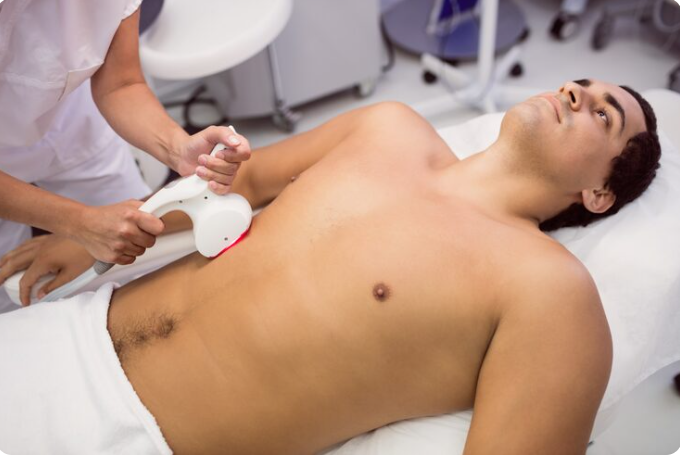
Fat freezing uses controlled cooling to target fat cells beneath the skin.
Fat cells are particularly sensitive to cold temperatures. When exposed to carefully controlled cooling, some of these cells become damaged and are gradually cleared away by the body’s natural processes.
Over the following weeks and months, the treated fatty layer may become smaller, creating a more refined contour.
According to the American Society of Plastic Surgeons, cryolipolysis can produce an average reduction of approximately 20% in the targeted fatty bulge. This does not mean losing 20% of total body fat or overall body weight.
Radiofrequency body contouring
Radiofrequency treatments use controlled heat to affect tissue beneath the skin.
Depending on the equipment and treatment protocol, radiofrequency energy may be used to target fatty tissue or encourage collagen remodelling.
This can make certain treatments suitable for men experiencing mild skin laxity alongside unwanted fat.
However, results are generally modest, and significant loose skin cannot be removed through radiofrequency treatment alone.
Electromagnetic muscle stimulation
Electromagnetic muscle stimulation uses energy to produce repeated muscle contractions.
These treatments are generally marketed towards people who want to improve the appearance of muscle tone, particularly around the abdomen.
Although some devices may produce measurable changes in muscle thickness, results vary and the evidence is more limited than for established fat reduction procedures.
Importantly, these treatments are not substitutes for resistance training or a balanced exercise programme.
Male chest fat: Can non-surgical treatments reduce man boobs?
One of the most common body confidence concerns among men is excess fullness around the chest.
Often referred to informally as ‘man boobs’, this appearance can affect men of different ages, weights and fitness levels.
Some men notice that their chest remains soft or rounded even after losing weight or developing stronger pectoral muscles.
However, understanding the underlying cause is essential before considering cosmetic treatment.
There are two main reasons why a man’s chest may appear enlarged.
The first is pseudogynaecomastia, which involves excess fatty tissue around the chest. The second is true gynaecomastia, a condition involving enlargement of glandular breast tissue.
This distinction matters because fat reduction treatments cannot remove enlarged glandular tissue.
For men whose chest fullness is primarily caused by fatty deposits, non-surgical male chest and breast reduction may be worth exploring.
Treatments such as fat freezing can potentially reduce selected areas of chest fat, provided the tissue is suitable and the device is appropriate for that area.
The results are typically gradual rather than immediate, and multiple sessions may be necessary.
Men with genuine gynaecomastia should seek medical assessment, as the NHS explains that the condition may be associated with hormonal changes, medication or other underlying causes.
A new breast lump, persistent pain, nipple discharge or changes in the skin should also be assessed by a GP rather than treated as a purely cosmetic concern.
Double chin reduction: Can men achieve a sharper jawline without surgery?
A defined jawline is often associated with a leaner facial appearance, but excess fat beneath the chin can affect men regardless of their overall body weight.
Submental fat, commonly known as a double chin, can develop due to genetics, ageing and weight gain.
For some men, it remains noticeable even after substantial weight loss.
This can be particularly frustrating because reducing body fat does not guarantee that the area beneath the chin will become significantly slimmer.
Non-surgical treatments offer several potential approaches to addressing this concern.
Fat freezing can be used with appropriately designed equipment to target suitable fatty deposits beneath the chin. The controlled cooling process damages some of the fat cells, which are then gradually cleared by the body.
Certain injectable fat reduction treatments may also be considered, although their regulatory status, suitability and availability differ, and they should only be administered by appropriately qualified professionals.
Men interested in improving their facial profile may wish to investigate non-surgical double chin treatment to understand which approaches could be appropriate for their concerns.
However, not every double chin is caused entirely by excess fat.
Loose skin, facial anatomy and the position of the jaw can all influence the appearance of the neck and chin.
For this reason, a professional consultation is important before deciding whether fat reduction is likely to achieve the desired improvement.
Back fat and love handles: Why these areas can be difficult to shift
The lower back and sides of the waist are particularly common areas of stubborn fat accumulation in men.
Even those who regularly attend the gym may notice soft deposits around their waistline, commonly referred to as love handles.
Back fat can also develop around the upper back, beneath the shoulder blades and towards the sides of the torso.
These areas can become more noticeable when wearing fitted shirts, sportswear or tailored clothing.
Although maintaining a calorie deficit can reduce overall body fat, it is impossible to guarantee that fat will disappear from these locations first.
This explains why some men reach a healthy weight yet remain dissatisfied with the shape of their waist or back.
For those researching how to reduce back fat, a combination of sustainable lifestyle habits and appropriately selected body contouring treatments may provide a useful starting point.
Fat freezing can target certain localised deposits around the back and flanks, depending on the equipment used and the amount of accessible fatty tissue.
The objective is not to create dramatic weight loss but to reduce specific fatty bulges that affect the overall silhouette.
For example, a man who has developed stronger shoulders and back muscles through resistance training may still have excess fat around his lower waist.
Reducing suitable fatty deposits in this area could help improve the appearance of his existing physique.
However, outcomes depend on individual anatomy, and body contouring should complement rather than replace regular physical activity and good nutrition.
How effective is fat freezing for men?
Of the available non-invasive fat reduction technologies, cryolipolysis has a relatively established evidence base.
A systematic review published in the medical literature found reductions in measured fat thickness across the studies examined, although the results varied depending on the measurement method and treatment protocol.
This supports the potential effectiveness of fat freezing for reducing selected fatty deposits.
Nevertheless, the results should be understood in context.
Fat freezing does not produce the same dramatic changes as liposuction, nor is it designed to treat obesity.
Instead, it generally creates gradual and relatively subtle improvements in the contours of specific areas.
The American Academy of Dermatology notes that results from non-invasive fat removal procedures typically develop over several months, with some people requiring more than one session.
Men considering treatment should therefore avoid expecting an immediate transformation.
The best candidates are generally those with small, localised areas of excess fat, relatively stable body weight and realistic expectations about the outcome.
What about the risks and side effects?
Although non-surgical body contouring avoids many of the risks associated with invasive operations, it is not entirely risk-free.
Fat freezing can cause temporary redness, swelling, bruising, numbness and tenderness around the treated area.
There is also a rare but important complication known as paradoxical adipose hyperplasia.
This occurs when fatty tissue in the treated area enlarges rather than decreases. It may require surgical correction and has been reported more frequently in male patients.
Other possible problems include uneven contours, asymmetry and disappointing results.
For these reasons, men should choose practitioners with appropriate training, suitable equipment and a clear understanding of the limitations of each procedure.
A thorough consultation should include a discussion of expected outcomes, medical history, contraindications, potential complications and alternative treatments.
Is non-surgical body contouring better than liposuction?
The answer depends on the amount of fat being treated and the individual’s expectations.
Liposuction is a surgical procedure that physically removes fatty tissue from selected areas of the body.
It can achieve more substantial changes than most non-invasive treatments, but it also involves greater risks, recovery requirements and expense.
Non-surgical body contouring generally offers a less invasive approach with shorter recovery periods.
Many people can return to normal daily activities relatively quickly, although temporary discomfort and swelling may occur.
For a man wanting a modest reduction in a small fatty area, a non-surgical procedure may be sufficient.
Someone with substantial excess fat, significant loose skin or enlarged glandular breast tissue may need a different approach.
Neither option should be considered universally superior. The appropriate choice depends on the underlying concern, medical suitability and desired outcome.
How long do body contouring results last?
One of the main attractions of fat freezing is that the fat cells destroyed during treatment are permanently removed from the treated area.
However, this does not mean that future weight gain is impossible.
Remaining fat cells can still expand if someone gains weight, potentially affecting the appearance of the treated area.
Ageing and changes in skin elasticity can also influence results over time.
Maintaining a stable weight through regular physical activity, balanced nutrition and sustainable lifestyle habits is therefore important.
Men who view body contouring as a finishing treatment rather than a shortcut to weight loss are generally better positioned to have realistic expectations.
The growing importance of male body confidence
Conversations about male appearance are changing.
Men are becoming more comfortable discussing concerns that might previously have been dismissed or ignored, including chest fullness, stubborn abdominal fat and changes in facial definition.
Social media, fitness culture and increased awareness of cosmetic technologies have contributed to greater visibility of these issues.
However, body confidence should not depend on achieving an unrealistic physique.
There is nothing inherently unhealthy about having some fat around the chest, stomach or waist, and cosmetic treatment is a personal choice rather than a necessity.
For men who do wish to make changes, understanding the available options is far more valuable than pursuing dramatic promises or unrealistic before-and-after images.
The future of non-surgical body contouring for men
As aesthetic technologies continue to develop, men have access to a broader range of non-surgical treatments than ever before.
Fat freezing, radiofrequency procedures and muscle stimulation technologies all offer different approaches to improving body contours.
However, effectiveness varies considerably, and choosing the correct treatment is more important than simply choosing the newest technology.
For suitable candidates, non-surgical fat reduction can provide measurable improvements in stubborn fatty areas without the recovery associated with surgery.
The key is recognising what these procedures can and cannot achieve.
They cannot replace healthy lifestyle habits, guarantee a perfectly sculpted physique or correct every cause of unwanted fullness.
But when used appropriately, non-surgical body contouring can offer men an additional option for refining areas that remain resistant to conventional weight management.
Ultimately, the most successful approach combines realistic expectations, professional guidance and a commitment to maintaining long-term health.